Friday, February 04, 2011

Cyber attacks: from Facebook to nuclear weapons

The Telegraph has a short piece on how cyber attacks are set to become part of everyday life in the 21st Century, citing such targets as social networking sites to secret nuclear facilities; and the need to establish new global conventions: 


World leaders are facing calls to amend the Geneva and Hague conventions to draw up “rules of engagement” for “cyber war”. Here are some of main types of cyber attack:
Denial-of-Service (DoS):
Also known as distributed denial-of-service attack (DdoS), this involves crmiinals attempting to bring down or cripple individual websites, computers or networks often by flooding them with messages.
Malware:
Malicious software designed to take over individuals’ computers in order to spread a bug onto other people’s devices or social networking profiles. It can also infect a computer and turn it into part of a “botnet” – networks of computers controlled remotely by hackers known as “herders” to spread spam or virusus. 

State cyber attacks:
US and Israeli intelligence agencies are believed to have recently used a mysterious computer virus called Stuxnet to carry out an invisible attack on Iran’s secretive nuclear programme.
President Mahmoud Ahmadinejad recently admitted that its facilities had been infected by the programme which appears to target and disable uranium enrichment centrifuges....
Read original post - 'Cyber attacks: from Facebook to nuclear weapons'

-

Monday, January 31, 2011

Britons spend more time driving than socialising

It appears that despite rising petrol prices, the average UK motorist now clocks up a record 7,413 miles per year, according to new research. Well....this is modern life in our 'iron cages'!

Britons spend more time driving than socialising 

Britons have become so reliant on their cars that most spend more than one working day (10 hours) every week driving. This compares to just 3.7 hours spent walking, 2.7 hours showering and 4.6 hours socialising with friends and family.

The yearly total of 7,413 miles is the equivalent of driving from London to Cape Town and comes at an average costs of £1,078. As the need for social, shopping and commuting mobility has increased, motorists now spend nearly two more days driving every year than they did ten years ago. The average motorist now spends three full years of their life driving. Men spend 533 hours behind the wheel each year, which is longer than women who spend 506 hours driving each year. Men are also more likely to undertake longer, one-off drives - spending 21 hours a year driving on weekend trips and 29 hours behind the wheel on business.

The top journey for women on the other hand is the daily drive to work (122 hours a year), followed by shopping trips (91 hours) and visiting friends and family (96 hours).

Read more at the original post - 'Britons spend more time driving than socialising'

-

Friday, January 28, 2011

‘Stranded: An Eruption of Disruption’

The latest edition of the journal 'Mobilities' is now released: Stranded: An Eruption of Disruption’ and the mayhem that followed the eruption of Eyjafjallajökull volcano some of the articles have been kindly given free access by their authors which we hope you will download and enjoy.  

 
        Stranded: An Eruption of Disruption
Thomas Birtchnell; Monika Büscher       ole0FREE   
        Anticipation, Materiality, Event: The Icelandic Ash Cloud Disruption and the Security of Mobility
Peter Adey; Ben Anderson               
        On the Edge of Chaos: European Aviation and Disrupted Mobilities
Michael O’Regan                
        A Fiasco of Volcanic Proportions? Eyjafjallajökull and the Closure of European Airspace
Lucy Budd; Steven Griggs; David Howarth; Stephen Ison   ole1FREE   
        Grounded: Impacts of and Insights from the Volcanic Ash Cloud Disruption
Jo Guiver; Juliet Jain         
        People and Technologies as Resources in Times of Uncertainty
David Barton           
        Emotional Eruptions, Volcanic Activity and Global Mobilities – A Field Account from a European in the US During the Eruption of Eyjafjallajökull
Ole B. Jensen          
        Inspired by Eruptions? Eyjafjallajökull and Icelandic Tourism
Karl Benediktsson; Katrín Anna Lund; Edward Huijbens           
        Eyjafjallajökull 4′33″: A Stillness in Three Parts
Daryl Martin           
        Fire as a Metaphor of (Im)Mobility
Bülent Diken    ole2FREE   
Individual Articles    
        Constructing Global/Local Subjectivities – The New Zealand OE as Governance through Freedom
Anika Haverig          
        The Circular International Migration of New Zealanders: Enfolded Mobilities and Relational Places
Allan M. Williams; Natalia Chaban; Martin Holland


-

Wednesday, January 26, 2011

Researchers launch mobile device 'to spot paedophiles'

Lancaster University is back on the digital map of research as its Child Defence project has launched a mobile device 'to spot paedophiles'.See here:

A mobile phone application which claims to identify adults posing as children is to be released.
The team behind Child Defence says the app can analyse language to generate an age profile, identifying potential paedophiles.

Isis Forensics developed the tool after parental concerns over children accessing sites on their mobiles.
But child protection experts warned against such technology lulling people into thinking they are safe. 

Child Defence project leader James Walkerdine, based at Lancaster University, said: "This software improves children's chances of working out that something isn't right."Parents told us they would much prefer to see software solutions that empowered and educated their children to help them protect themselves."

Child campaigning charity NSPCC hopes the application will encourage children to report the crime - but warned of complacency.


Read more at - 'Researchers launch mobile device 'to spot paedophiles''

-

Monday, January 24, 2011

Mobile to be used to control satellite

It appears that British engineers are to send a mobile phone into space to control a satellit...according to this post in The Telegraph:

The phone, which will run Google's Android operating system, will take pictures of the Earth later this year.
The project is being run by a British firm called Surrey Satellite Technology Limited, based in Guildford, which wants to test a modern phone in the most hostile environment possible, the BBC reported.

Although it will be a smartphone, the precise model has not been disclosed. It will be the first time a phone has gone into orbit.

Shaun Kenyon, the project manager, said: "Modern smartphones are pretty amazing.
"They come now with processors that can go up to 1GHz, and they have loads of flash memory. First of all, we want to see if the phone works up there, and if it does, we want to see if the phone can control a satellite.


Read more at - 'Mobile to be used to control satellite'

-

Thursday, December 23, 2010

Use of Mobile Phones Banned in Indian Village to Stop illicit Romance

Now here's an interesting 2011 story to begin the year with - one village in India and their approach to mobile phones - to halt illicit romances!!

Use of mobile phones has been banned by a local council in northern India. The reason given is to ban unmarried women from carrying mobile phones and also to halt romances between youngsters from different castes.


In Uttar Pradesh state, the Baliyan council has decided to ban mobile phone after a series of elopements. Over the last year, at least 23 couples eloped against their parents wishes. Jatin Raghuvanshi, a village elder, commented that the panchayat (assembly) was convinced that the reason of the recent surge in series of elopement was cell phones as the young loves planned their elopement over using them...

...A spokesman for the village assembly, Satish Tyagi, has said that all parents were told to ensure that their unmarried daughters do not use cell phones. The Indian constitution has banned caste discrimination but still it influences many aspects of life, especially marriage.


Read more at - 'Use of Mobile Phones Banned in Indian Village to Stop illicit Romance'

-

Friday, November 26, 2010

Car or computer? How transport is becoming more connected

As was discussed in the book 'After the Car' modern cars are becoming highly sophisticated in how they are connected, in terms of integrating with transport information as well as the potential for being part of a social network. This interesting article outlines some of the recent developments:

Fiat's eco:drive software Fiat is using software that tells drivers how to make better, and more fuel efficient, choices behind the wheel.
 
They are among the 612 Mini E cars being trialed in the US, UK and Germany since 2009. These plug-in electric models are leased to customers, and BMW - the owner of the Mini - is monitoring every aspect of the cars' use, in almost every scenario, as they are put through their paces.The amount of data that can now be collected about how drivers use their cars is unprecedented. And the impact of so much information is potentially huge. Imagine having your car post MOT reminders to your social networks, or share your location with friends, or prove that you were not responsible for an accident.

Behaviour changing 

A British company, Riversimple, has designed a range of tiny hydrogen-powered cars, which it will roll out in Leicester in 2012.They will collect every minute detail about how the cars are used. If the pilot goes well, they are already discussing ways of connecting the cars to social media, and sharing data about how the cars are used."Drivers could play games to see who is driving the most efficiently," says Rosie Reeves, Riversimple's sustainability officer.Italian carmaker Fiat has been compiling data from the Blue&Me navigation systems installed on many of its cars over a six-month period. It may be the largest such data harvest done by a major carmaker.
 
"We can extract a number of data - on how the pedals are used, petrol consumption, braking," says Candido Peterlini, vice president for product development at Fiat. It developed eco:Drive from the data collected from 420,000 car journeys of 5,700 drivers in five countries.


 Read more at - 'Car or computer? How transport is becoming more connected'

-

Monday, November 15, 2010

DocNext on IDFA International Documentary Festival Amsterdam

Here is some information on an upcoming film festival where young and new film-makers use media technologies to frame/capture their environments. It looks promising -


Doc Next is a special program of IDFA, featuring short documentaries by a new generation of young film talents from Europe using accessible media technologies to zoom in on their environments. For the first time, their documentaries are being shown on the big festival screen.

At the Doc Next talk show, young documentary makers take centre stage. We seize their films and stories to discuss the challenges and possibilities of user-generated media content with festival organisers, media broadcasters and documentary experts. How can do-it-yourself documentaries inspire different media domains and contribute to inclusive public opinion sharing in Europe? How can this new generation of storytellers help mainstream media to attract new audiences? 

Doc Next is hosted by Leena Pasanen, executive producer at Yle Fact & Culture. Yle is Finland's national public service broadcasting company. Leena has built up a strong reputation as one of the most internationally orientated and engaged European commissioning editors, especially known for her support to new talent.
Contributing guests are Doc Next’s young filmmakers Ahang Bashi (Sweden), Solomon Walter-Kelly (UK), Erhan Arik (Turkey), Vieru Dan Ilian (Romania) and media professionals Patricia Aufderheide (Professor of Film and Media Arts in the School of Communication at American University in Washington), Noel Goodwin (Youth Programmer, British Film Institute, UK), Arman Tadevosyan (Curator and initiator 5th FLOOR in Armenia), Beadie Finzi (Founding director Britdoc Channel 4, UK) and ARTE. 

Location
Doc Next will take place on 20 November 2010, 14.30 – 18.00 (drinks at 16.30), in the Escape venue. Escape is situated at Rembrandtplein 11, Amsterdam. 
Public transportation: take tram 4, 9 or 20 from Amsterdam Central Station, get off at Rembrandtplein. If you are coming by car you can park at Stopera Parkeergarage, Waterlooplein, Amsterdam.

European Cultural Foundation and IDFA
 

Wednesday, October 27, 2010

The bubble car is back

Welcome to the world of rapidly developing urban transit - a shift towards smaller, urban-centric networked vehicles for the mega-cities of the future...and this article from the Economist is spot on.....on the 'bubble' that is!


MANY car designers are convinced that a radical change in automobile technology is going to be needed for the crowded megacities of the future. By 2030 more than 60% of the world’s population is expected to be living in cities, up from 50% now, and more of them will be able to afford cars. The need to reduce emissions, an acute scarcity of land for roads and parking, and the prospect of laws restricting conventional cars all point to the idea that different and smaller types of vehicle will be in demand. With that in mind, some of those designers are coming up with things that look a lot like a vehicle that was familiar more than 50 years ago. Welcome to the return of the bubble car.

Bubble cars were built to provide cheap personal transport. Most were two-seaters with just three wheels. They became particularly popular when fuel prices shot up in 1956, during the Suez crisis. One of the first was the Italian-made Iso Isetta. Germany was a prolific builder, too. Messerschmitt and Heinkel, forbidden to ply their former trade of building military aircraft, turned to bubble cars as a peacetime alternative. BMW, meanwhile, re-engineered the Isetta to use an engine from one of its motorcycles.

Rising incomes, falling fuel prices and changing fashions did for the original bubble cars, but the idea seems ripe for revival and three new versions, known as EN-Vs (for Electric Networked-Vehicles), are enthralling the crowds at the Expo 2010 in Shanghai. They can be driven normally or operated autonomously, with their occupants doing other things while the cars automatically avoid bumping into one another. They can also be summoned from their parking places using a mobile phone. And instead of being powered by smoky little petrol engines, they are driven electrically. What is most intriguing, however, is that they balance on just two wheels. 

The three EN-Vs, each with a different body shape, were built by a partnership between General Motors (GM), an American company, and Shanghai Automotive Industry Corporation, one of China’s biggest carmakers.


 Read more at 'The bubble car is back'

Thanks David for the heads up!

-

Thursday, October 21, 2010

Motorists abandon cars as costs rise

The UK's Telegraph has a short piece on what it sees as a cost-cutting trend - people changing their driving habits; i.e., driving less...which may be a growing trend if the price of oil continues to rise as the value of the £ continues to drop...

As many as 8 per cent of car owners have given up driving altogether because of the expense, the survey by moneysupermarket.com found. And 57 per cent of those polled said they had reduced the amount of time spent behind the wheel. 

But 30.5 per cent of the 860 people surveyed said they were sticking to their usual driving pattern, as they could just about afford to, while 4.5 per cent said they were not changing their habits at all. Steve Sweeney, head of car insurance at moneysupermarket.com said: ''We're all looking at ways to lower our everyday outgoings and getting behind the wheel is a real drain on finances. ''With recent fuel price hikes and increasing costs of car insurance, drivers are turning savvy and making changes to their usual habits to drive down costs.'' 

He went on: ''Cutting out driving altogether is the ultimate sacrifice to take. Shopping around for the best deal on your car insurance cover is crucial to reduce the overall costs of motoring; providers count on your apathy to reap the profits and do not reward your loyalty with a cheaper premium. 

''Taking further steps like fitting an approved car alarm or immobiliser and parking in a locked garage if possible are other ways to reduce the overall cost.'


Read original post - 'Motorists abondon cars as costs rise'

-

Monday, October 11, 2010

Google to unveil driverless cars

Now Google is getting in on the act - trying to come up with a 'driverless car'...well, makes sense when you consider that the major issue is the software component. And, in fact, it sounds like Google is having some success....read on.....


A Google car has even driven through the steep and curvy Lombard Street in San Francisco [GALLO/GETTY] 
Google is planning to introduce driverless cars in an ambitious project that has already seen the cars secretly driving through busy California roads, clocking a total of 1,000 miles without any human intervention.

The California-based company said on its website the cars have done more than 140,000 miles with only occasional human control.

According to an official Google blogpost by Sebastian Thrun, the company's software engineer, one car even successfully negotiated San Farncisco's Lombard Street, one of the steepest and curviest street in the US.
But Thrun believes that the self-driving cars are still about eight years away from mass production.
The technology developed by Google enables the automated cars to drive themselves using video cameras, radar sensors and a laser range finder to "see" other traffic, as well as detailed maps.

Self-driving cars have been around for over four decades, but a breakthrough came in 2004 when they were tested in a series of Grand Challenge events organised by the US government. Following the failure of the first contest, a Stanford team led by Thrun built the car that won a race against a vehicle built by a Carnegie Mellon University team. And within two years, another such event showed that self-driving vehicles can successfully negotiate busy urban roads.

The 'google edge'
Google's street view data gives it an edge with photographs of every street in the US, UK, Ireland and many major world cities, enabling the cars to plan their routes by seeing junctions, roads well in advance, according to data from the company.


Read more at - 'Google to unveil driverless cars'

Monday, September 20, 2010

Smart cars to mean safer driving

As was discussed in my book with John Urry - After the Car - one side of in-car technologies will be increased 'intelligent sensors' placed into cars. As this recent post from the BBC explains,


Cars could soon be ringing the emergency services themselves if they are involved in a crash.
Sensors embedded in future vehicles could also let emergency services work out the severity of the crash and how many people were involved.

The predictions came at a symposium considering the changes ushered in by the spread of small, smart processors. The growing number of on-board computers could also spell big changes for the way people drive.

"The car is probably going to be the most compute-intensive possession that we will have," said Steve Wainwright, European manager at Freescale Semiconductor which makes many of the chips inside car control systems.

Mr Wainwright said average cars have 25-30 electronic control units onboard already and high-end cars probably carry up to 80. These tiny computers are in charge of many car systems such as stability control, power distribution, safety and many others. 

Increasingly, said Mr Wainwright, they are helping to augment a person's driving skill and that trend would only continue as technologies such as collision detection systems and radar become more commonplace.


Read more at 'Smart cars to mean safer driving'

-

Friday, September 17, 2010

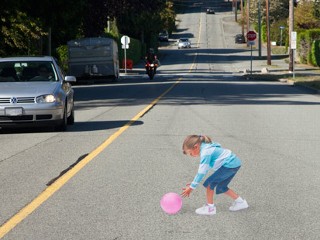
City scares drivers with ’3D girl’ that runs into road

Good idea or a sure fire accident? The debate is on....and what would be your reaction if you 'think' you saw a young child in the road.....albeit a clever 3D drawing??


For the past week, drivers on 22nd Street in the ritzy suburb of West Vancouver, British Columbia, have come across an alarming sight: A small girl running out into the road to chase a ball.

As their hearts leap to their throats and their feet move to the brake pedal, the drivers realize it's an illusion -- a "3D" image drawn on the pavement to get drivers to slow down. The "3D girl" isn't really 3D -- it's a cartoon drawn on the pavement in a distorted fashion so as to appear three-dimensional, the culmination of a pilot project from the British Columbia Automobile Association, an affiliate of the AAA, and the city of West Vancouver.

It's an innovative idea that some critics say could cause accidents. "I think it's awful. I think it's dangerous," Sam Schwartz, a former traffic commissioner in New York City, told ABC News. "I think drivers are always scanning and suddenly they see this image up, they may very well panic."


Read original post at - 'City scares drivers with ’3D girl’ that runs into road'

-

Wednesday, September 15, 2010

Britain's 'seven social tribes' mapped

An interesting novel way of cartography when it comes to mapping Britain's 'social tribes'...aA team of cartographers at London's City University have created a visualisation of Britain which makes 'the traditional map of the British Isles look outdated by comparison'.The Telegraph article reports that:

South of England as visualised by the Seven Social Tribes of Britain by City University London's giCentre.
 
The mosaic-like map beautifully visualises the "Seven Social Tribes of Britain", combining postcode information with demographic data from the Government.
This map emphasises different types of people and their concentration in different areas of the country, unlike traditional maps which highlight geography.

Each set of pixels on the map is a postcode and is coloured according to economic measures based on census data...The seven tribes of Britain visualised on the map are: Blue Collar Communities, City Living, Countryside, Prospering Suburbs, Constrained by Circumstances, Typical Traits and Multicultural.


Read more at - 'Britain's 'seven social tribes' mapped'

-

Monday, September 13, 2010

Virtual worlds: is this where real life is heading?

Things have been quite for a while concering virtual worlds, now that the hype around Second Life has more or less died down....anyway, this recent post from The Guardian has some useful recent overviews, such as concerning apps like Farmville:

Recently a man bought a space station for $330,000, while last month Small Planet Foods, a subsidiary of General Foods, introduced a new brand of organic blueberries. What have these two products got in common? Neither actually exist. Well, not except as pixels in the virtual worlds where they are traded. Only the money is real.

The space station was sold in the virtual world Entropia Universe, which has its own economy and currency. The buyer, who converted his $300,000 into 3.3m PED (Project Entropia dollars), is convinced that virtual shops on his virtual space station will produce virtual profits that can be converted back into real dollars. The blueberries represent a "brand extension" of a product that exists in the real world as US company General Foods aims to establish a presence in FarmVille, a game which exists as an application on Facebook and which at its peak has had nearly 80 million players. It is a classic example of a new genre.

Farmers in FarmVille buy cartoon-like virtual farm animals, which have to be regularly fed, or crops that require fertiliser (virtual, of course) to help them grow, in order to be more successful than their friends. The real-time game has its own virtual currency that makes it easier for members to trade and for the game's makers to profit. Parent company Zynga has revenues of more than $600m a year which come mainly from FarmVille, despite competition from half a dozen other farm games on Facebook. Zynga is reckoned to be worth between $4bn and $5bn, based on the value of investment stakes that have been taken in it.

To many, this seems crazy: why spend real money to buy a virtual currency to purchase food in order to stop a pig that doesn't exist from dying through lack of food? The easy answer is why not – if that's what you want to do. It is arguably a lot more "real" – whatever that means these days – than, say, sitting like a couch potato watching a soap on television.

This might still seem the stuff of fantasy but it's where real life seems to be heading: according to some analysts, we are in the midst of a virtual revolution that might one day be considered as important as the industrial revolution. Nic Mitham, founder of KZero, a Cambridge-based consultancy, says that there are 175 virtual worlds that are live or in live beta and that the number of registered users to them has risen from 880 million in the fourth quarter of 2009 to 1.1 billion today, a 25% increase within six months in the middle of a recession. The registered population of virtual worlds (even if this is not the same as active users) is greater than the populations of the US and Europe combined.


Read more at - 'Virtual worlds: is this where real life is heading?'

-

Friday, September 10, 2010

Tesco launches UK's first 'drive-thru' supermarket

True 'car mobility' now comes to grocery shopping - getting your bags without even having to leave the car. Tesco is trialling a new service that will allow customers to pick up their weekly shop via 'drive-thro': 

The supermarket will launch the trial at a store in Baldock, Hertfordshire, this week before a possible national roll-out.Under the scheme – which aims to appeal to busy mothers and shopaphobes alike – customers will order shopping online and then drive to a designated area in the store's car park to have their products loaded into their car at a pre-arranged time. Tesco said that the service has been designed for shoppers who want their goods picked and packed but who do not have the time to wait at home for delivery. 

Laura Wade-Gery, chief executive of Tesco.com and Tesco Direct, said: "This will be especially popular with busy mums who have the school run and children's activities to manage. It also offers a solution to parents who want to avoid the challenge of shopping in a busy store with children in tow."


Read more at - 'Tesco launches UK's first 'drive-thru' supermarket'

-

Wednesday, September 08, 2010

GPS Trackers Secretly Placed in Unilever Laundry Detergent Boxes

We are now seeing the shift of GPS tracking devices from larger commercial objects to marketing objects...which mirrors WalMarts move into RFID chipping its products:


The household cleaning product giant Unilever has secretly placed GPS tracker transmitters in laundry detergent boxes to track consumers to their homes. With an array of electronic sensors, team of Unilever agents can now pinpoint the exact location of the GPS trackers and walk right up to your front door. They can even remotely set off a beeper inside the box using radio electronics.

The point of all this? It's part of Unilever's new marketing campaign to convince consumers in Brazil to purchase more boxes of Omo laundry detergent.

The GPS trackers, you see, are only embedded in "prize winning" boxes of Omo detergent. If you happen to buy one of these GPS tracked boxes, you're a "winner" and Unilever agents then show up at your door with a video camera crew and a prize. This new detergent marketing contest was detailed in an Ad Age article called Is Your Detergent Stalking You? (http://adage.com/globalnews/article...)

That article explains that Unilever "...has teams in 35 Brazilian cities ready to leap into action when a box is activated. The nearest team can reach the shopper's home 'within hours or days,' and if they're really close by, 'they may get to your house as soon as you do.'"

This creepy "Big Brother" marketing idea is apparently exactly the kind of thing the Unilever company approves of: Spying on your customers. Unilever, by the way, is the parent company that brings you brands like Lipton tea, Skippy peanut butter, Axe cologne, and the infamous Slim-Fast sugar drink that's somehow positioned as a "weight loss" product.


Read more at - 'GPS Trackers Secretly Placed in Unilever Laundry Detergent Boxes'

-

Monday, September 06, 2010

Google, CIA Invest in ‘Future’ of Web Monitoring

The Danger Room blog has more information on the 'predicted future' software that Google and Pentagon interests are investing in:

The investment arms of the CIA and Google are both backing a company that monitors the web in real time — and says it uses that information to predict the future.

The company is called Recorded Future, and it scours tens of thousands of websites, blogs and Twitter accounts to find the relationships between people, organizations, actions and incidents — both present and still-to-come. In a white paper, the company says its temporal analytics engine “goes beyond search” by “looking at the ‘invisible links’ between documents that talk about the same, or related, entities and events.”
The idea is to figure out for each incident who was involved, where it happened and when it might go down. Recorded Future then plots that chatter, showing online “momentum” for any given event.

“The cool thing is, you can actually predict the curve, in many cases,” says company CEO Christopher Ahlberg, a former Swedish Army Ranger with a PhD in computer science.

Which naturally makes the 16-person Cambridge, Massachusetts, firm attractive to Google Ventures, the search giant’s investment division, and to In-Q-Tel, which handles similar duties for the CIA and the wider intelligence community. 

It’s not the very first time Google has done business with America’s spy agencies. Long before it reportedly enlisted the help of the National Security Agency to secure its networks, Google sold equipment to the secret signals-intelligence group. In-Q-Tel backed the mapping firm Keyhole, which was bought by Google in 2004 — and then became the backbone for Google Earth.


Read more at - 'Google, CIA Invest in ‘Future’ of Web Monitoring'

-

Friday, September 03, 2010

Mind-controlled app calls your friends with the power of thought

A new app for the Nokia N900’s Maemo platform has emerged that claims to be able to dial a contact using only the power of thought:


ThinkContacts is designed to allow a “Motor disabled person to make a phone call to a desired contact by himself/herself”. Requiring a special headset to read users’ brainwaves, it uses brain activity to determine which of three contacts on the screen the user wants to call.

While the app is looking quite basic at present, the project’s wiki at Forum Nokia only opened six days ago meaning this is likely to be an early-stage project. The wiki describes how the app works:
“The user controls the selection of the desired contact by controlling his/her level of meditation and attention. If the user’s level of attention is higher than 70% the software switches to the next contact in the list, if it is lower than 30% the software switches to the previous, otherwise the current contact will not be switched. If the user’s meditation level is higher than 80%, the software makes a phone call to the contact located at the center of the screen.”


Read more at - 'Mind-controlled app calls your friends with the power of thought'

-

Wednesday, September 01, 2010

Mind-reading marketers have ways of making you buy

New Scientist has an intriguing post on the power of neuromarketing....which is coming to a magazine cover near you!


TAKE A look at the cover of this week's New Scientist magazine (right). Notice anything unusual? Thought not, but behind the scenes your brain is working overtime, focusing your attention on the words and images and cranking up your emotions and memory. How do we know? Because we tested it with a brain scanner.

In what we suspect is a world first, this week's cover was created with the help of a technique called neuromarketing, a marriage of market research and neuroscience that uses brain-imaging technology to peek into people's heads and discover what they really want. You may find that sinister. What right does anyone have to try to read your mind? Or perhaps you are sceptical and consider the idea laughable. But ...


Read more at - 'Mind-reading marketers have ways of making you buy'

-