CNet News relates in Australia Post tracks mail delivery using RFID how more than 12,000 radio frequency identification (RFID) tags are being used in letters every month to track the delivery of mail by Australia Post:
'The government business enterprise has replaced manual monitoring of mail delivery with RFID tags. In its annual report released Wednesday, Australia Post said RFID monitoring of mail came into effect in July after being run in parallel with manual monitoring for six months.
"We installed radio frequency identification technology that will enhance our ability to monitor our service performance and provide a better analysis of potential problems within our delivery network," the report said. Under the system, monitoring company Research International inserts RFID tags into "test letters" that can be tracked throughout the course of their journey.'
Question is - will it improve the service? Personally, I think all politicians should carry RFID tags...
Thanks to Smartmobs
Friday, October 20, 2006


Thursday, October 19, 2006
Immobility of desperation?
Well, trying to cross borders is where the immobility of mobility becomes a paramount juxtaposition. And here I thought it would be illustrative to show 2 pictures of desperation: known simply as "the chair guy"
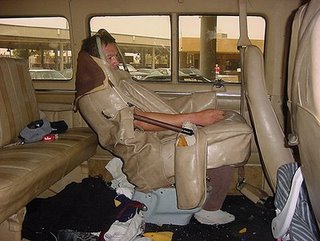
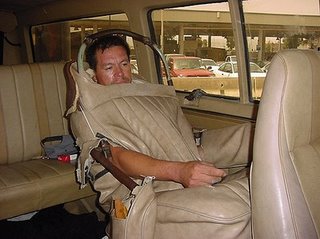
Via Subtopia
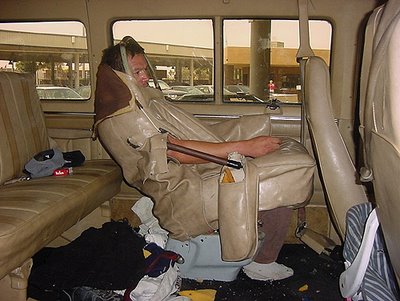

Via Subtopia
Cartographic Oddities
Maybe its a question you've asked yourselves many times - I wonder how the world would look if....
Well, Strange Maps is a blog that focuses on odd maps, many that look on the world with redrawn boundaries or strange ideas. Includes examples of a redrawn map of the Middle East; Imperial Texas, Greater Albania or what Europe might have looked like (in French eyes) if the Germans had won the war. And more!
Via Cartographic Oddities
Well, Strange Maps is a blog that focuses on odd maps, many that look on the world with redrawn boundaries or strange ideas. Includes examples of a redrawn map of the Middle East; Imperial Texas, Greater Albania or what Europe might have looked like (in French eyes) if the Germans had won the war. And more!
Via Cartographic Oddities
Wednesday, October 18, 2006
Aviopolis
Aviopolis is both a book about airports and a project about these 'cities of the future'. Artists Ross Harley and Gillian Fuller have photographed, videoed, and crafted text around the airport - their site Aviopolis is a recommended must see.
Aviopolis states that: 'Airports are cities of mobility. Their citizens are passengers who form a migratory population that must negotiate an infrastructure that is perpetually upgrading. The contemporary airport offers "laboratory conditions" to analyse the global interconnections of life in the information age.
Aviopolis is the first book-length critical study of how information, architecture, people and machines are converging into a new urban form dominated by logistics. The project presents a unique approach to the study of airports, blending cutting-edge cultural analysis with rich visual material. It will be of interest to all those concerned with current debates on globalisation, urbanism, information, architecture and the politics of mobility.'
See also Gillian Fuller's work on 'The Queue Project'
Aviopolis states that: 'Airports are cities of mobility. Their citizens are passengers who form a migratory population that must negotiate an infrastructure that is perpetually upgrading. The contemporary airport offers "laboratory conditions" to analyse the global interconnections of life in the information age.
Aviopolis is the first book-length critical study of how information, architecture, people and machines are converging into a new urban form dominated by logistics. The project presents a unique approach to the study of airports, blending cutting-edge cultural analysis with rich visual material. It will be of interest to all those concerned with current debates on globalisation, urbanism, information, architecture and the politics of mobility.'
See also Gillian Fuller's work on 'The Queue Project'
Mobiles 'to help track diseases'
BBCNews writes in Mobiles 'to help track diseases' how mobile phone technology is being developed to help manage the spread of diseases such as HIV and bird flu:
'The software is designed to allow field workers using handsets to send and receive data on disease outbreaks along with patient and drug information. The project is a collaboration between technology firm Voxiva and the trade association for mobile operators, GSMA.
Trials of the relatively low-cost application are underway in Rwanda, Africa and in Indonesia. The program works by sending the data through the general packet radio service (GPRS) network, and if this is unavailable, it can divert to an SMS data channel, normally used for text messages.
It is programmed using java language, so can work across different handsets and operators.'
A more appropriate use of mobile-tracking technologies.
'The software is designed to allow field workers using handsets to send and receive data on disease outbreaks along with patient and drug information. The project is a collaboration between technology firm Voxiva and the trade association for mobile operators, GSMA.
Trials of the relatively low-cost application are underway in Rwanda, Africa and in Indonesia. The program works by sending the data through the general packet radio service (GPRS) network, and if this is unavailable, it can divert to an SMS data channel, normally used for text messages.
It is programmed using java language, so can work across different handsets and operators.'
A more appropriate use of mobile-tracking technologies.
Spy Drones over Liverpool City?
There were earlier reports that police were thinking of employing spy drones over Liverpool City (UK) in order to curb anti-social violence. Now that the 'word' got out the police have played down reports that spy planes could be flown high above the streets of Merseyside as a way to fight anti-social behaviour. According to the BBC:
'Merseyside Police's new anti-social behaviour (ASB) task force is exploring a number of technology-driven ideas. But while the use of surveillance drones is among them, they would be a "long way off", police said.
The squad's aim is to use any criminal or civil law available to help curb anti-social behaviour. A spokesperson for Merseyside Police said: "The idea of the drone is a long way off, but it is about exploring all technological possibilities to support our war on crime and anti-social behaviour.
"What we have got here and now is a new task force using all legislation available to it, to stop the misery of anti-social behaviour, which is something that affects communities up and down the country." '
Read full at Police play down spy planes idea
Well... at least it shows that they were/are seriously considering the idea...
'Merseyside Police's new anti-social behaviour (ASB) task force is exploring a number of technology-driven ideas. But while the use of surveillance drones is among them, they would be a "long way off", police said.
The squad's aim is to use any criminal or civil law available to help curb anti-social behaviour. A spokesperson for Merseyside Police said: "The idea of the drone is a long way off, but it is about exploring all technological possibilities to support our war on crime and anti-social behaviour.
"What we have got here and now is a new task force using all legislation available to it, to stop the misery of anti-social behaviour, which is something that affects communities up and down the country." '
Read full at Police play down spy planes idea
Well... at least it shows that they were/are seriously considering the idea...
Tuesday, October 17, 2006
Europe to Purchase Hydrogen-Fueled Buses
Green Car Congress states that six cities and regions in Europe and Canada are joining forces to buy hydrogen-powered buses:
'Representatives of the partners signed a Memorandum of Understanding on purchasing the hydrogen-powered buses at the meeting of the Third General Assembly of the Europe Hydrogen and Fuel Cell Technology Platform (HFP) in Brussels. The cooperating cities and regions are: Amsterdam, Barcelona, Berlin, British Columbia Province, Hamburg and London.
The European Commission voiced full support for the initiative as sending a strong signal to prospective suppliers that a potential market exists for the technology.'
Read Europe, Canada Ally to Purchase Hydrogen-Fueled Buses
'Representatives of the partners signed a Memorandum of Understanding on purchasing the hydrogen-powered buses at the meeting of the Third General Assembly of the Europe Hydrogen and Fuel Cell Technology Platform (HFP) in Brussels. The cooperating cities and regions are: Amsterdam, Barcelona, Berlin, British Columbia Province, Hamburg and London.
The European Commission voiced full support for the initiative as sending a strong signal to prospective suppliers that a potential market exists for the technology.'
Read Europe, Canada Ally to Purchase Hydrogen-Fueled Buses
Blog aims to record everyday life
BBC News posts in Blog aims to record everyday life how thousands of people across Britain are expected to contribute to a project aiming to create an online archive of a day in the life of the country. Sounds like a real blog-project?! The story is...
'The National Trust is encouraging people to record a diary of their day on a website, as part of what is being called "Britain's biggest blog". The blogs will then be stored by the British Library and at other locations.
The trust says it will create a "fascinating social history archive" of everyday life for future generations. Tuesday has been picked as an "ordinary day much like any other of no particular national significance". National Trust director general Fiona Reynolds said: "We want this day to have its own place in history and be a snapshot of everyday life at the beginning of the 21st Century.'
I wonder if soon most of our days can/will be recorded in similar ways - snapshots for the future - Life Caching
'The National Trust is encouraging people to record a diary of their day on a website, as part of what is being called "Britain's biggest blog". The blogs will then be stored by the British Library and at other locations.
The trust says it will create a "fascinating social history archive" of everyday life for future generations. Tuesday has been picked as an "ordinary day much like any other of no particular national significance". National Trust director general Fiona Reynolds said: "We want this day to have its own place in history and be a snapshot of everyday life at the beginning of the 21st Century.'
I wonder if soon most of our days can/will be recorded in similar ways - snapshots for the future - Life Caching
Monday, October 16, 2006
Bus Rapid Transit
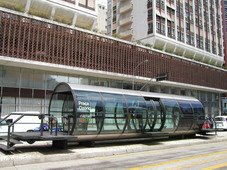
Good news - the bus rapid transit system of Bogotá is getting some global recognition:
'This summer, the bus rapid transit system of Bogotá, Colombia, earned the distinction of being the world’s first mass transport project to be approved (PDF) for participation in the Kyoto Protocol’s Clean Development Mechanism (CDM). As such, it is a model for similar transport-related CDM initiatives in the pipeline worldwide. Brazil, Chile, China, Ecuador, Laos, Panama, and Peru are all establishing or planning mass transport systems based on rapid buses, according to the Andean Development Corporation, the multilateral financial institution that helped develop the bid.'
Read more on this from Worldchanging
Satellites to deliver Ultra Violet via SMS
Ah.. the futures so bright I gotta wear shades...! Or is it so bright that I need to wear protective cream?
Now, you can get the UV index sent to your mobile phone... isn't that smart?
'According to the World Health Organization (WHO), 60,000 deaths are caused annually by excessive exposure to ultraviolet (UV) radiation. In 'Satellites help ensure safe sunning,' the European Space Agency (ESA) reports that a new service using its satellites can deliver the UV index to your cellphone via SMS. The Happy Sun Mobile (HSM) service also will advise about how to protect you and send you details about sea surface temperature and sea water transparency if you plan to dive. So far, the service is limited to Sardinia and Tuscany, Italy, but several operators will start to use it next summer...
...Thanks to an innovative service called HappySun, the UV Index can be delivered directly to mobile phones via SMS or can be accessed on the Internet. HappySun calculates the UV Index throughout the day by using ESA satellite data on radiation, ozone and cloud coverage. [...] "HappySun is a tool for the primary prevention of skin cancer," Franco Marsili, Director of the Dermatology Clinic at the Versilia Hospital in Italy, said. "The aim is to educate people about the intelligent 'use' of the sun."'
Via Roland Piquepaille's Technology Trends
Now, you can get the UV index sent to your mobile phone... isn't that smart?
'According to the World Health Organization (WHO), 60,000 deaths are caused annually by excessive exposure to ultraviolet (UV) radiation. In 'Satellites help ensure safe sunning,' the European Space Agency (ESA) reports that a new service using its satellites can deliver the UV index to your cellphone via SMS. The Happy Sun Mobile (HSM) service also will advise about how to protect you and send you details about sea surface temperature and sea water transparency if you plan to dive. So far, the service is limited to Sardinia and Tuscany, Italy, but several operators will start to use it next summer...
...Thanks to an innovative service called HappySun, the UV Index can be delivered directly to mobile phones via SMS or can be accessed on the Internet. HappySun calculates the UV Index throughout the day by using ESA satellite data on radiation, ozone and cloud coverage. [...] "HappySun is a tool for the primary prevention of skin cancer," Franco Marsili, Director of the Dermatology Clinic at the Versilia Hospital in Italy, said. "The aim is to educate people about the intelligent 'use' of the sun."'
Via Roland Piquepaille's Technology Trends
More Airports With e-Passport Readers
Well, it seems that this airport issue is not going away soon! It appears that the U.S. Department of Homeland Security (DHS) has announced that e-Passport readers are now in place and they are processing holders of e-Passports at additional airports, including Honolulu International Airport and Kona International Airport:
'Installation of the new readers is the next in a series of deployments that began at the San Francisco International Airport in September and will continue at U.S. airports through the next few weeks in preparation for an October 26, 2006, deadline requiring that U.S. ports of entry have the capability to compare and authenticate data in e-Passports issued by Visa Waiver Program (VWP) countries. Since deploying e-Passport readers at San Francisco International Airport three weeks ago, DHS has processed more than 1,944 e-Passports.
Deployment of e-Passport readers is another step in a process to further enhance the security of international travel documents while continuing to facilitate the flow of legitimate travel and trade to the United States. An e-Passport securely identifies the individual, defends against identity theft protects privacy and makes it difficult for individuals to cross borders using fraudulent documents.'
Read in full at More Airports With e-Passport Readers
Via Smartmobs
'Installation of the new readers is the next in a series of deployments that began at the San Francisco International Airport in September and will continue at U.S. airports through the next few weeks in preparation for an October 26, 2006, deadline requiring that U.S. ports of entry have the capability to compare and authenticate data in e-Passports issued by Visa Waiver Program (VWP) countries. Since deploying e-Passport readers at San Francisco International Airport three weeks ago, DHS has processed more than 1,944 e-Passports.
Deployment of e-Passport readers is another step in a process to further enhance the security of international travel documents while continuing to facilitate the flow of legitimate travel and trade to the United States. An e-Passport securely identifies the individual, defends against identity theft protects privacy and makes it difficult for individuals to cross borders using fraudulent documents.'
Read in full at More Airports With e-Passport Readers
Via Smartmobs
Friday, October 13, 2006
Air passengers 'could be tagged'
I wrote in an earlier post about the developments going into airport RFID tagging via boarding cards. It seems that this 'vision' is becoming further realised - even to the point of getting picked up by the national media!
BBC News reports in 'Air passengers 'could be tagged'':
'Electronically tagging passengers at airports could help the fight against terrorism, scientists have said. The prototype technology is to be tested at an airport in Hungary, and could, if successful, become a reality "in two years". The work is being carried out at a new research centre, based at University College London, set up to find technological solutions to crime...
"The basic idea is that airports could be fitted with a network of combined panoramic cameras and RFID (radio frequency ID) tag readers, which would monitor the movements of people around the various terminal buildings."
The plan, he said, would be for each passenger to be issued with a tag at check-in.
He said: "In our system, the location can be detected to an accuracy of 1m, and video and tag data could be merged to give a powerful surveillance capability." '
Mobility will no longer be a given...
BBC News reports in 'Air passengers 'could be tagged'':
'Electronically tagging passengers at airports could help the fight against terrorism, scientists have said. The prototype technology is to be tested at an airport in Hungary, and could, if successful, become a reality "in two years". The work is being carried out at a new research centre, based at University College London, set up to find technological solutions to crime...
"The basic idea is that airports could be fitted with a network of combined panoramic cameras and RFID (radio frequency ID) tag readers, which would monitor the movements of people around the various terminal buildings."
The plan, he said, would be for each passenger to be issued with a tag at check-in.
He said: "In our system, the location can be detected to an accuracy of 1m, and video and tag data could be merged to give a powerful surveillance capability." '
Mobility will no longer be a given...
Clever Cars
NewScientistTech report on 'Clever cars shine at intelligent transport conference' tells how smart vehicles under development are sensoring their own safety and parking:
'Smart vehicles capable of following the flow of traffic, parking themselves and even warning drowsy or distracted drivers to pay attention to the road are among the highlights of the Transport Systems World Congress, which takes place this London, UK, this week.
One of the recurring themes of the show is vehicle intelligence, and the inventions on display range from unfinished prototypes to models already on the market in Japan.
A prototype system developed by German company Ibeo enables a car to automatically follow the vehicle ahead. At the press of a button an infrared laser scanner in the car's bumper measures the distance to the next vehicle and a computer maintains a safe distance, stopping and starting if it becomes stuck in traffic.'
In a related matter of interest - just how many cars are in the world? Well...
Physics Factbook began collecting stats on car ownership in 1900, when somewhere between 4,142 and 8000 passenger cars existed in the United States (the only country to manufacture cars at that time). In 1985, there were 375 million passenger cars and 109 million commercial vehicles worldwide. Just 85 short years resulted in 6 million percent growth!
A 1997 report claimed that in that year, over 600 million motor vehicles existed in the world. It went on to predict that if the existing trends continued, that number would double in the next 30 years. So in 2030, we could see 1.2 billion cars - thought parking was bad now?
'Smart vehicles capable of following the flow of traffic, parking themselves and even warning drowsy or distracted drivers to pay attention to the road are among the highlights of the Transport Systems World Congress, which takes place this London, UK, this week.
One of the recurring themes of the show is vehicle intelligence, and the inventions on display range from unfinished prototypes to models already on the market in Japan.
A prototype system developed by German company Ibeo enables a car to automatically follow the vehicle ahead. At the press of a button an infrared laser scanner in the car's bumper measures the distance to the next vehicle and a computer maintains a safe distance, stopping and starting if it becomes stuck in traffic.'
In a related matter of interest - just how many cars are in the world? Well...
Physics Factbook began collecting stats on car ownership in 1900, when somewhere between 4,142 and 8000 passenger cars existed in the United States (the only country to manufacture cars at that time). In 1985, there were 375 million passenger cars and 109 million commercial vehicles worldwide. Just 85 short years resulted in 6 million percent growth!
A 1997 report claimed that in that year, over 600 million motor vehicles existed in the world. It went on to predict that if the existing trends continued, that number would double in the next 30 years. So in 2030, we could see 1.2 billion cars - thought parking was bad now?
Mobilities, Networks, Geographies

A new book to be of interest to those following mobilities: 'Mobilities, Networks, Geographies' by Jonas Larsen, John Urry and Kay Axhausen, Ashgate 2006.
This is a substantially revised version of the report 'Social Networks and Future Mobilities' commissioned by the UK Department of Transport submitted in early 2006. The book puts forward one of the first social science studies of the geographies of social networks and related mobilities of travel, communications and face-to-face meetings. It examines five interdependent mobilities that form and reform these geographies of networks and travel in the contemporary world.
Chapters include: Researching Networks and Travel: An introduction; Social Networks; Meetings and Networks; Mobilities; Research Design; Geographies of Networks and Mobilities; Travel and Meetings; Coordinating Networks and Travel; and Research and Policy Futures.
Wednesday, October 11, 2006
The Future of Migration - Part Two
Part 2 of YaleGlobal Online two-part series on the future of migration, economist Lant Pritchett argues that the forces building up to another wave of mass migration face opposition in the form of ideas:
'Simply put, he says, "the primary reason there is not more migration is that the citizens of the industrialized world don't want it." People in the industrialized world - the main destination for migrants - often believe that their own poor would suffer if cheaper foreign labor were allowed in. Another idea they hold is that trade in goods is sufficient to create a convergence of incomes worldwide. Yet, Pritchett notes, there is no evidence that this is the case. In addition, he writes, the notion that sending enough aid to poor countries could obviate the need for increasing immigration is also unsubstantiated. The democratic rich countries' approach, which consists of promoting equality within their own nations while disregarding the suffering of people in poor countries, is another point of resistance to immigration.'
Read full here
'Simply put, he says, "the primary reason there is not more migration is that the citizens of the industrialized world don't want it." People in the industrialized world - the main destination for migrants - often believe that their own poor would suffer if cheaper foreign labor were allowed in. Another idea they hold is that trade in goods is sufficient to create a convergence of incomes worldwide. Yet, Pritchett notes, there is no evidence that this is the case. In addition, he writes, the notion that sending enough aid to poor countries could obviate the need for increasing immigration is also unsubstantiated. The democratic rich countries' approach, which consists of promoting equality within their own nations while disregarding the suffering of people in poor countries, is another point of resistance to immigration.'
Read full here
Mobile phone parking payments
This article Westminster to trial mobile phone parking payments looks at how Westminster Council has become the latest borough to trial cashless parking payments, with drivers in central London able to purchase tickets with a mobile phone:
'Drivers in the busy West End and on Harrow Road can pay with a phone call or text message from today as part of the six-month trial.They can also top up parking fees without returning to the car, thereby avoiding an encounter with the area's wardens.
Parking attendants can check that the correct payment has been made using a handheld computer, meaning no proof of purchase is required.'
Fancy being mobile-surveyed by traffic wardens? Sorry... parking attendents!
Thanks to Smartmobs
'Drivers in the busy West End and on Harrow Road can pay with a phone call or text message from today as part of the six-month trial.They can also top up parking fees without returning to the car, thereby avoiding an encounter with the area's wardens.
Parking attendants can check that the correct payment has been made using a handheld computer, meaning no proof of purchase is required.'
Fancy being mobile-surveyed by traffic wardens? Sorry... parking attendents!
Thanks to Smartmobs
Digital Planet October 9 2006
In this week's Digital Planet: security risks to our home computers - finding out about super passwords and how many companies are not updating these regularly leaving themselves vulnerable to attack.
Learn more about hackers - do they fit the stereotype? Researchers are trying to discover exactly the type of person who likes the challenge of breaking into someone else's machine.
And air traffic controllers texting pilots - at first glance perhaps not the safest of options but at the Eurocontrol centre in Maastricht this alternative to radio communication is being tested and is proving very useful.
Download here
Learn more about hackers - do they fit the stereotype? Researchers are trying to discover exactly the type of person who likes the challenge of breaking into someone else's machine.
And air traffic controllers texting pilots - at first glance perhaps not the safest of options but at the Eurocontrol centre in Maastricht this alternative to radio communication is being tested and is proving very useful.
Download here
Drives to Ethanol
Toyota it seems is not satisfied with developing hybrid electrical cars or even hydrogen fuel cells - its latest innovative developments are in cars that run on 100% ethanol:
'The Japanese company, now the second-biggest automaker in the world, will come out with a car in Brazil in Spring 2007 that can run on 100 percent ethanol, as well as on a blend of gas and ethanol...
...The pricing and the name of the car have not been revealed yet, he added. Brazil is a natural spot to launch the car. Brazilians produce ethanol there from sugar cane, and a number of gas stations sell it.'
Read full article at CNET News
'The Japanese company, now the second-biggest automaker in the world, will come out with a car in Brazil in Spring 2007 that can run on 100 percent ethanol, as well as on a blend of gas and ethanol...
...The pricing and the name of the car have not been revealed yet, he added. Brazil is a natural spot to launch the car. Brazilians produce ethanol there from sugar cane, and a number of gas stations sell it.'
Read full article at CNET News
Monday, October 09, 2006
Car Transportation Problems?

Car Transportation Problems? In that case, check-out 'Ele-Car Corporation'. According to their webpage:
'The revolutionary Ele-Car Personal Transportation System will use privately-owned vehicles called Ele-CarsTM which will be about the size of family cars, but very lightweight and self-elevating. That is, the Ele-Cars will quickly raise themselves from the ground to an overhead guideway, and then they will travel non-stop to their destination. When they arrive, they will lower themselves back down to the ground again. The System will retain the advantages of the car and road system - there will be no need to walk to a transit stop and wait, or to change from one vehicle to another.
The Single-Mode Ele-Cars will be very low cost. They will travel only on the guideway at speeds up to 110 kph (68 mph). They will operate automatically, so no driver will be needed. The Dual-Mode Ele-Cars, however, will be capable of being driven on roads to a nearby guideway, where they will also travel automatically. Their maximum road speed will be limited to 60 kph (37 mph).'
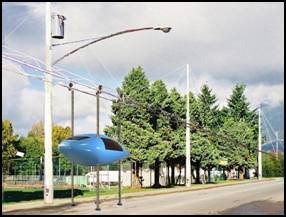
Is this a viable alternative? Comments please...
First Responders Can Tag Victims For Tracking
In 'First Responders Can Tag Victims For Tracking' is discussed the emergency relief concept of tracking victims of injury from the scene of the accident to the hospital:
'The governments of Belgium, the Netherlands, and Germany in the last few weeks have been reviewing a system to wirelessly track disaster victims from the scene of the incident to the hospital. Only Belgium has been piloting a customized version of the Victim Tracking and Tracing Systems (ViTTS) that includes RFID technology.'
Read full here
Via Smartmobs
'The governments of Belgium, the Netherlands, and Germany in the last few weeks have been reviewing a system to wirelessly track disaster victims from the scene of the incident to the hospital. Only Belgium has been piloting a customized version of the Victim Tracking and Tracing Systems (ViTTS) that includes RFID technology.'
Read full here
Via Smartmobs
Subscribe to:
Posts (Atom)